
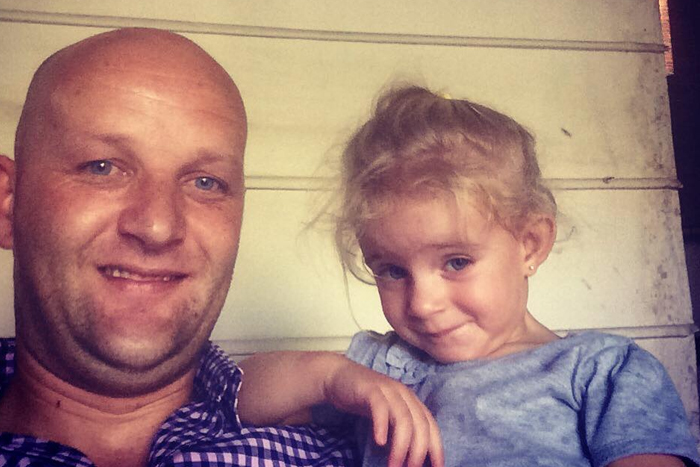
So, now that I have a beautiful daughter in my life, who has grown up a lot since the time I originally wrote this article, I was looking for ways to support her development and I wanted to try make her smarter than the average kiddo. And guess what?

I say again, I was trying. So, in my quest for this, I found out a few things like sign language for babies and also now the effects television OR one may call it, screen time, has on kids.
But before we get started, I just want to let you know that the most important facts I took out of all this was that TV provides no educational benefits for any child under the age of 2. Worst part is that it actually steals time from you for the activities you two need to develop the little ones brain... like interacting with other people and playing. #justsaying
Just to put you at ease with my post, so you know I'm not talking rubbish, a large amount of research was done on and is known about children and television. Researchers have studied how TV affects kids' sleep, weight, grades, behaviour and lots more.
In this post, I will try explain in my own words so keep on reading!
Firstly, a child learns a lot more and more efficiently from real interaction... with real people and real things, rather than pretend things they see on a screen.
Screen time also robs her of time that she needs to develop important skills like language, creativity, motor (no, not driving stuff... movement of fingers and arms and legs and so forth) and social skills. These skills are developed in her first two years... which is a very critical time for brain development - through play. Exploration and conversation.
Did you know? TV viewing numbs your kid’s mind?
It prevents your child from exercising initiative, prevents being intellectually challenged, prevents thinking analytically, and prevents using her imagination. I cannot imagine a life without imagination and I think it’s pretty cruel robbing your little superhero of it. It's literally the essence of our being. You should be encouraging her to use it more! Expand it.
Fun fact: Imagination boosts creativity and problem-solving! Studies show that daydreaming or letting your mind wander can actually help you come up with creative solutions to problems. When you imagine different scenarios, your brain is essentially practicing real-world skills, which can improve cognitive flexibility and help you think outside the box! #NoJokes
Did you know...
Like me, this probably scares you, right? So, I thought I would give you a few guidelines which I got from sources like The American Academy of Paediatrics (AAP) on children and screen time:
TV viewing among kids is at a ten-year high. On average, children aged 2-5 spend 32 hours a week in front of a TV - watching television, DVDs, DVR, videos and using a game console. Kids aged 6-11 spend about 28 hours a week in front of the TV. The vast majority of this viewing (97%) is from live TV.
For those people who love television, screen time does have its good side and can open whole new worlds for kids. Like traveling the globe, learning about other cultures and exposing them to ideas outside of their communities and circles.
It may be tempting to put your baby or kid in front of the television, especially to watch shows created just for children under age two. But the American Academy of Paediatrics says: Don't do it!
Excessive TV viewing can contribute to poor grades, sleep problems, behaviour problems, obesity, poor reading skills, short term memory skills and risky behaviour.
For obesity, kids who watch too much TV, according to the Medical Association, often snack on junk food while watching TV. They are also influenced by commercials to consume unhealthy food and influences parents spending budgets. What also adds to this is that they are not running, jumping or doing activities that burn calories and increase metabolism like kids usually do.
Did you know? surveys tell us that 92.2% of 1-year-olds have already used a mobile device, some starting as young as 4 months.
It takes around 18 months for a baby's brain to develop to the point where the symbols on a screen come to represent their equivalents in the real world.
What children need most to learn is interaction, especially with the people around them. That doesn't mean that they shouldn't video-chat with a distant grandparent or a deployed parent, but when it comes to day-to-day learning they need to touch things, shake them, throw them, and most of all... to see the faces and hear the voices of those they love the most.
Apps can teach toddlers to tap and swipe at a screen, but studies tell us that these skills don't translate into real-world learning.
I hope this helps you and please, let others know that television or screen time is bad for kids under the age of 2. Help them grow and make your kid smarter than the rest.
After using these techniques and tips, my daughter has become the wildest dreamer ever. Her imagination is wild and she prefers to play outside than rather sitting inside watching tv or playngo n the iPad.
Take care and be blessed.
A few of my sources:
Kids Health.org | C.S. Mott Children’s Hospital | Raise Smart Kids | Healthy Children.org

Martin is a digital marketing specialist, a producer and always online. His educational background is Digital Marketing and has given him a broad base from which to approach many topics. His little girl comes first and in his spare time he really enjoys making music and creating content.














 martin_grobler